Quiet as a Premium: How Acoustic Quality Separates Toronto's Finest Residential Addresses

Photo: ASally Ruth, CC BY-SA 4.0, via Wikimedia Commons
Toronto is a city that rarely pauses. From the rhythmic percussion of construction cranes to the persistent hum of arterial traffic, urban sound is an inescapable companion for most residents of the downtown core. Yet within this orchestrated noise, certain neighbourhoods have managed to preserve something increasingly rare: the experience of genuine quiet. For buyers who have spent time evaluating premium properties across the city, acoustic comfort has quietly emerged as a decisive — if underarticulated — differentiator.
At 1 Deer Park Crescent, the conversation about sound quality is not merely abstract. It is embedded in the very geography of the neighbourhood and the architectural character of the building itself.
The Noise Profiles of Toronto's Residential Districts
Not all urban noise is created equal. Acoustic researchers and urban planners distinguish between transient noise — the sharp, unpredictable sounds of sirens, horns, and construction — and ambient noise, the steady background hum that defines a neighbourhood's baseline volume. Both matter, but transient noise tends to have a more pronounced effect on sleep quality, concentration, and general wellbeing.
In Toronto's most intensely developed corridors — portions of King West, the Entertainment District, and sections of Yonge Street south of Bloor — transient noise events are frequent and largely unavoidable. Proximity to transit infrastructure, high pedestrian density, and the concentration of commercial activity combine to create soundscapes that, while energising for some, prove genuinely fatiguing over time.
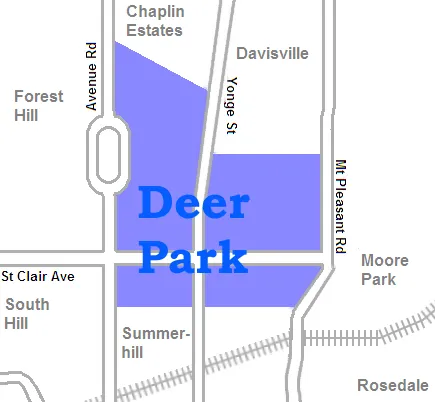
Midtown neighbourhoods tell a different story. Areas such as Rosedale, Forest Hill, and Deer Park benefit from a combination of reduced arterial traffic, generous tree canopy, and lower commercial density. These qualities do not eliminate urban sound — no neighbourhood within the city limits can claim that — but they meaningfully alter its character and intensity.
Why Mature Urban Design Matters for Sound
The acoustic advantages of Deer Park are not accidental. They are the product of decades of deliberate urban planning and the organic maturation of a residential enclave that was never designed to accommodate the volume of activity found in Toronto's commercial districts.
The neighbourhood's tree-lined streets are particularly significant. Mature deciduous and coniferous trees act as natural sound buffers, absorbing and deflecting noise before it reaches building facades. Studies in urban acoustics have consistently demonstrated that dense street-level vegetation can reduce perceived noise levels by several decibels — a meaningful difference in a context where even modest reductions translate to noticeably calmer living environments.
The street geometry of Deer Park further contributes to this effect. The crescent-shaped configuration of streets in the area naturally limits through-traffic, reducing the volume of vehicles that would otherwise use residential roads as shortcuts. This is in sharp contrast to the grid-based layouts of many downtown neighbourhoods, where traffic dispersal is less controlled and residential streets absorb a disproportionate share of urban movement.
Building Specifications and Interior Acoustic Performance
Neighbourhood acoustics represent only one dimension of the equation. The internal acoustic performance of a building — determined by construction methods, glazing specifications, and floor-plate design — is equally consequential for the quality of daily life within a suite.
High-rise residences built to contemporary standards in Toronto's premium segment typically incorporate double or triple-glazed window assemblies, concrete construction methods that attenuate sound transmission between units, and mechanical systems designed to minimise operational noise. These specifications are not universal across the city's condominium stock, and the difference between buildings that meet these standards and those that do not is immediately perceptible.
At the eighth floor, a suite at 1 Deer Park Crescent occupies a position that benefits from meaningful elevation above street-level noise sources while remaining below the threshold where wind-related sounds become a factor. This intermediate height represents a considered acoustic sweet spot — removed from the immediate environment of the street, yet grounded enough that the building's structural mass provides effective insulation.
Sound Quality as an Underrated Luxury Amenity
The luxury real estate market in Toronto has historically emphasised visible amenities: granite countertops, concierge services, rooftop terraces, and proximity to high-end retail. Acoustic quality, by contrast, is experienced rather than photographed. It does not feature prominently in listing descriptions or marketing materials. And yet, among buyers who have lived in multiple properties across the city, it consistently emerges as one of the qualities they reflect upon most after a move.
The ability to open a window on a summer evening and hear birdsong rather than traffic, to conduct a telephone call without raising one's voice, to sleep without the intrusion of sirens — these are not trivial considerations. They are the conditions that determine whether a residence feels like a sanctuary or merely an address.
Deer Park has long understood this. Its identity as one of Toronto's most coveted residential districts rests partly on the intangible quality of its environment — the sense that the neighbourhood operates at a different register from the city that surrounds it. Acoustic comfort is central to that identity, even when it goes unnamed.
Evaluating Acoustic Quality Before You Buy
For buyers who wish to assess the acoustic character of a property before committing, a few practical approaches are worth considering. Visiting a suite at different times of day — particularly during morning and evening peak traffic periods — provides a more accurate impression of ambient noise than a midday viewing. Paying attention to sound transmission between floors and through party walls during a visit can reveal the quality of a building's construction. And noting the acoustic character of the street itself — the presence or absence of mature trees, the volume of through-traffic, the proximity of transit infrastructure — offers reliable context for what life in that location will actually sound like.
At 1 Deer Park Crescent, these visits tend to confirm what the neighbourhood's reputation has long suggested: that quiet, in Toronto, is genuinely rare, and that its presence in a residential setting represents a form of luxury that no renovation can retrofit.