From Victorian Enclave to Urban Landmark: The Quiet Reinvention of Deer Park
There are neighbourhoods that change quickly, shaped by developers and market forces. And then there are neighbourhoods like Deer Park—places that have evolved slowly, deliberately, and with a rare continuity of character that distinguishes them from almost every other pocket of Toronto. To understand why Deer Park endures as one of the city's most desirable addresses, one must first understand where it began.
A Neighbourhood With Memory
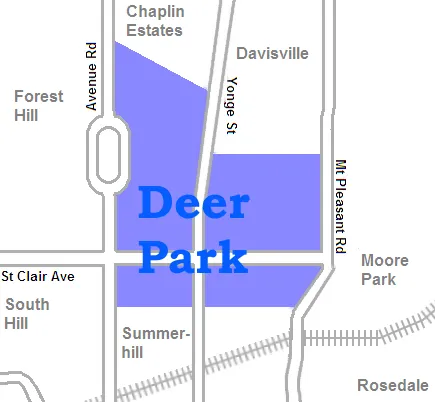
Deer Park takes its name from a nineteenth-century estate owned by John Lea, whose property—complete with a deer park in the English tradition—occupied the rolling land north of what is now St. Clair Avenue West. When Toronto began to expand in the late Victorian era, this area attracted the city's professional class: lawyers, merchants, and civic leaders who sought distance from the industrial waterfront while remaining within reach of the growing downtown core.
The homes they built reflected those ambitions. Edwardian bay-and-gables, Queen Anne Revival detailing, and substantial red-brick construction defined the streetscapes that still anchor the neighbourhood's visual identity today. Unlike many Toronto neighbourhoods where mid-century development erased much of the original fabric, Deer Park retained its architectural heritage in ways that feel less like preservation and more like simple continuity. The bones of the neighbourhood were strong enough to survive every subsequent era of change.
The Yorkville Effect—and Why Deer Park Is Different
Any conversation about upscale Toronto real estate eventually turns to Yorkville. The two neighbourhoods are neighbours in the loosest geographical sense, yet they represent fundamentally different residential propositions. Yorkville is performative luxury—high-gloss retail, international hotel brands, and condominium towers that announce themselves with architectural bravado. It is a neighbourhood designed to be seen.
Deer Park, by contrast, is residential in its bones. There are no flagship boutiques on Deer Park Crescent, no valet-attended restaurants competing for attention. What exists instead is a quieter form of prestige: tree-lined streets, a genuine community of long-term residents, and proximity to Yorkville's amenities without subjection to its energy. For buyers who value privacy alongside access, this distinction is not incidental—it is the defining appeal.
The short walk to Bloor Street's cultural corridor, the Royal Ontario Museum, and the refined dining of the surrounding avenues means that Deer Park residents lack nothing in terms of urban convenience. They simply encounter it on their own terms.
Infrastructure Investment and the Modernisation of a Classic Address
Deer Park's evolution has not been purely organic. In recent years, the City of Toronto has directed meaningful infrastructure investment toward the midtown corridor, improving transit connectivity, pedestrian infrastructure, and green space maintenance in ways that have enhanced the neighbourhood's liveability without altering its fundamental character.
The expansion of the Eglinton Crosstown LRT, while centred further west, has reinforced the broader midtown narrative that positions Deer Park and the St. Clair Avenue corridor as central nodes in a more connected Toronto. Buyers who once weighed the relative convenience of downtown neighbourhoods against Deer Park's quieter setting now find the gap considerably narrowed.
At the same time, the neighbourhood's established zoning has largely protected it from the kind of dense, rapid development that has transformed other Toronto areas. New residential projects that do emerge—including towers along the Yonge Street spine—tend to be held to a higher standard of design and finish, partly because the existing neighbourhood context demands it.
Cultural Proximity as a Lifestyle Amenity
One of the less-discussed advantages of a Deer Park address is its proximity to Toronto's cultural infrastructure. The Royal Ontario Museum is within easy reach. The Toronto Reference Library, a remarkable civic institution, sits just to the south. The city's network of ravine trails, accessible from multiple points near Deer Park Crescent, offers a form of natural escape that is genuinely rare at this proximity to the urban core.
For buyers whose lifestyle priorities include arts, education, and outdoor activity—alongside the expected urban conveniences—Deer Park offers a concentration of such amenities that few Toronto neighbourhoods can match. It is the kind of environment that supports a full life rather than simply a prestigious postal code.
What Distinguishes Deer Park from Rosedale, Forest Hill, and Lawrence Park
Toronto's upscale midtown and north-midtown neighbourhoods each carry their own identity. Rosedale is insular and deeply rooted in old-money tradition. Forest Hill projects a certain formality tied to its history of large estate lots. Lawrence Park appeals to those who prioritise suburban scale within city limits.
Deer Park occupies a different position in this hierarchy—one that combines genuine urban connectivity with residential calm, architectural heritage with modern residential options, and exclusivity with accessibility. The availability of high-quality condominium residences, such as those at 1 Deer Park Crescent, allows buyers to participate in the neighbourhood without committing to the maintenance demands of a freehold property. That flexibility has broadened Deer Park's appeal to a wider range of discerning buyers: downsizers from larger homes, professionals relocating to Toronto, and international purchasers seeking an established address rather than a newly minted one.
The Long View: Why Deer Park Holds Its Value
Real estate analysts who track Toronto's mid-to-upper market consistently note Deer Park's resilience through market cycles. The neighbourhood's limited supply of residential units—constrained by zoning, heritage protections, and the simple fact that desirable land here has been built out for well over a century—creates a structural scarcity that supports values even during broader market softening.
But beyond supply dynamics, Deer Park holds its value because it holds its character. Neighbourhoods that reinvent themselves too aggressively tend to lose the very qualities that made them desirable in the first place. Deer Park has avoided that trap, evolving just enough to remain relevant while preserving the attributes—quiet streets, mature trees, architectural dignity, cultural proximity—that define its appeal across generations.
For the prospective buyer evaluating where to plant roots in Toronto, that continuity is not merely sentimental. It is a measurable, investable quality that distinguishes Deer Park from neighbourhoods that are fashionable today and uncertain tomorrow.