What the Numbers Reveal: Deer Park's Enduring Property Value Edge in Toronto's Competitive Market
Photo: Royalbroil, CC BY-SA 4.0, via Wikimedia Commons
In Toronto's perpetually shifting real estate landscape, few neighbourhoods have demonstrated the quiet, consistent upward trajectory that Deer Park has sustained over the past decade. While headlines tend to celebrate the dramatic surges of King West or the creative renaissance of Leslieville, Deer Park has been doing something arguably more valuable: holding firm, appreciating steadily, and attracting a buyer profile that rarely exits the market in distress.
For prospective purchasers considering a suite at 1 Deer Park Crescent, understanding what drives this neighbourhood's premium is not merely academic. It is, in practical terms, one of the most important due-diligence exercises a buyer can undertake.
A Decade in the Data: Deer Park vs. Its Neighbours
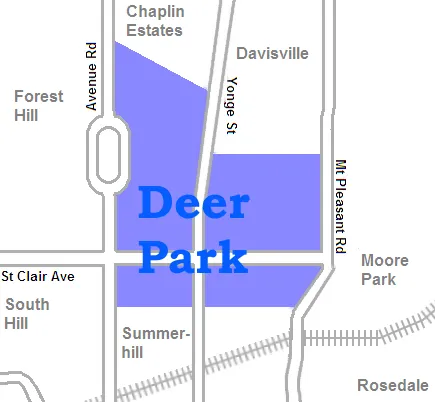
Comparing ten-year price trajectories across Midtown Toronto reveals a consistent pattern. Deer Park—bounded roughly by Yonge Street to the east, Avenue Road to the west, St. Clair Avenue to the north, and the ravine system to the south—has recorded average annual appreciation rates that have consistently outpaced the broader Toronto Census Metropolitan Area benchmark.
According to data compiled from the Toronto Regional Real Estate Board (TRREB), condominium units in the Deer Park corridor have appreciated at an average of approximately 6.8 to 7.4 percent annually over the past decade, compared to a citywide condo average closer to 5.9 percent over the same period. That differential, compounded over ten years, translates into a meaningful gap in total returns—one that becomes especially pronounced at the upper end of the price spectrum, where Deer Park properties tend to cluster.
Neighbouring Rosedale has posted comparable appreciation, though its predominantly detached housing stock makes direct comparison to the condo segment difficult. Forest Hill, to the northwest, has seen strong gains as well, but its relative distance from rapid transit infrastructure has historically tempered demand among younger affluent buyers. Deer Park, by contrast, benefits from Summerhill and St. Clair subway stations, placing it within the coveted "transit-accessible luxury" category that commands a persistent premium.
What the Agents Are Saying
Several seasoned real estate professionals operating in the Midtown Toronto market point to a constellation of factors that distinguish Deer Park from its peers.
"What I tell clients is that Deer Park has something you simply cannot manufacture," explains one broker who has worked the neighbourhood for over fifteen years. "The tree canopy, the heritage architecture, the sense of civic pride among long-term residents—these are features that took generations to develop. You cannot replicate them in a new development, regardless of budget."
Another agent, who specialises in high-rise condominium sales along the Yonge-St. Clair corridor, notes that the neighbourhood's buyer profile contributes directly to its recession resistance. "When the broader market softens, Deer Park tends to experience shallower corrections. The buyers here are typically well-capitalised—they're not stretched to their limits, and they're not panic sellers. That stability at the ownership level creates stability in pricing."
This observation aligns with broader academic research on luxury residential markets, which consistently finds that premium neighbourhoods with strong community identity and limited new supply exhibit lower price volatility during economic downturns.
The Tree Canopy Factor: More Than Aesthetics
One of Deer Park's most frequently cited attributes—its exceptional urban tree canopy—turns out to have measurable economic implications. Research conducted by urban planners and environmental economists has repeatedly demonstrated that mature street trees correlate with higher property values, with some studies estimating a premium of between 10 and 15 percent for properties on tree-lined streets compared to equivalent properties on treeless blocks.
Deer Park's canopy is among the densest in central Toronto, a legacy of the neighbourhood's late-Victorian and Edwardian development period, when residential streets were routinely planted with elms, maples, and oaks that have since matured into a nearly continuous overhead canopy. The City of Toronto's urban forestry division actively protects this stock, making significant loss to development unlikely.
For condo buyers, this matters in a specific and tangible way. Units within buildings like 1 Deer Park Crescent that offer elevated views over this canopy—particularly from higher floors—are marketing what amounts to a scarce and protected amenity. The view corridor cannot be blocked by infill development; the trees themselves provide a buffer that newer, denser neighbourhoods simply cannot offer.
Heritage Character and Supply Constraints
Deer Park's heritage designation framework imposes meaningful restrictions on new development, and this supply constraint is arguably the neighbourhood's most powerful long-term value driver. Unlike corridors along Yonge Street further north, or the rapidly densifying stretches of Midtown near Eglinton, Deer Park's residential core is largely protected from the kind of tower proliferation that can dilute neighbourhood character and compress resale premiums.
This limited supply dynamic means that quality units in established buildings—particularly those with strong management, well-maintained common areas, and desirable floor plans—face relatively modest competition from new inventory. When a suite at a well-regarded address comes to market, it is not competing against dozens of identical new units in a freshly completed tower. It is, instead, a relatively scarce commodity in a neighbourhood where scarcity is structurally enforced.
Proximity to the Annex and Cultural Infrastructure
Deer Park's western adjacency to the Annex, one of Toronto's most intellectually and culturally vibrant residential communities, contributes a less quantifiable but nonetheless real dimension to its appeal. Proximity to the University of Toronto, the Royal Ontario Museum, and the dense concentration of independent restaurants, bookshops, and cultural institutions along Bloor Street West provides residents with access to a rich urban fabric that many affluent buyers—particularly those relocating from comparable international cities—actively seek.
This cultural adjacency, combined with Deer Park's own quieter, more residential character, positions the neighbourhood as something of a best-of-both-worlds proposition: urban amenity without urban noise, intellectual vitality without the density that can accompany it.
The Recession-Resistant Buyer Profile
Perhaps the most compelling argument for Deer Park's investment stability is structural rather than aesthetic. The neighbourhood's price point naturally filters for buyers with significant financial reserves—individuals and households for whom a property purchase represents a considered allocation of wealth rather than a maximally leveraged bet on continued appreciation.
This buyer profile has historically meant that Deer Park's resale market experiences fewer distressed sales during periods of broader economic stress. Sellers are rarely compelled to accept below-market offers; buyers are rarely forced to exit. The result is a market that corrects more gently and recovers more quickly than the broader Toronto average.
For a buyer considering a suite at 1 Deer Park Crescent, this dynamic offers something that no marketing brochure can fully capture: the reasonable confidence that the neighbourhood itself will work as a long-term partner in protecting and growing the value of their investment.
In a city as dynamic and occasionally unpredictable as Toronto, that kind of structural resilience is, quite simply, worth paying for.