Why Deer Park Remains Toronto's Most Coveted Address for the Discerning Buyer
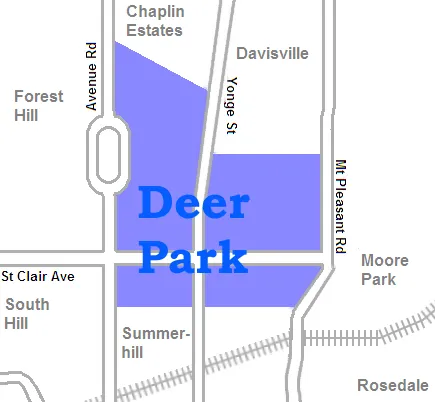
Photo: SimonP, CC BY-SA 3.0, via Wikimedia Commons
Nestled between the bustle of Yonge Street and the leafy quietude of Forest Hill, Toronto's Deer Park neighbourhood has long attracted buyers who demand both architectural distinction and urban convenience. Few addresses in Canada's largest city carry the same weight of history, cultural proximity, and residential prestige. For those evaluating a property such as 1 Deer Park Crescent, Unit 803, appreciating the neighbourhood's deeper character is not merely background reading — it is fundamental to understanding the investment itself.
A Neighbourhood Shaped by Time
Deer Park's origins trace back to the mid-nineteenth century, when the area was a semi-rural retreat for Toronto's merchant class. The name itself is said to derive from a small deer park maintained on the estate of Sheriff William Botsford Jarvis, whose landholdings once encompassed much of what is now a densely coveted residential pocket. Over the following decades, the neighbourhood transitioned from country retreat to one of the city's most carefully preserved urban enclaves.
Walking along streets such as Heath Street West or Roxborough Drive, one encounters an architectural record that spans late Victorian bay-and-gable detached homes, Edwardian red-brick semis, and graceful mid-century apartment buildings — all coexisting with a visual coherence that speaks to decades of attentive stewardship. The City of Toronto has recognised portions of the area through heritage designation, ensuring that the streetscape character will not be casually surrendered to redevelopment pressures.
This layered history is not mere sentimentality. It translates directly into sustained property values. Buyers who purchase in Deer Park are acquiring not only square footage but also a stake in a neighbourhood that the market has consistently regarded as irreplaceable.
Cultural Institutions Within Easy Reach
One of Deer Park's defining advantages is its relationship with Toronto's most significant cultural institutions. The Royal Ontario Museum, Canada's largest museum of natural history and world cultures, sits just minutes away along Bloor Street West. The institution draws both international visitors and dedicated local patrons, and its presence anchors the neighbourhood's intellectual identity.
Equally compelling is the proximity to Casa Loma, the early twentieth-century château that rises dramatically above the escarpment north of Dupont Street. While Casa Loma functions today as a museum and event venue, its silhouette remains a daily reminder of the neighbourhood's grand ambitions and enduring theatricality. Residents of buildings along Deer Park Crescent often enjoy elevated sightlines that incorporate this landmark in their everyday vistas.
The concentration of private schools — including Upper Canada College and Bishop Strachan School — within a short drive further cements the neighbourhood's appeal to families who regard education as a non-negotiable priority.
Market Trends and the Premium for Permanence
Real estate professionals consistently note that Deer Park properties attract a buyer profile distinct from those pursuing newer condominium towers in the Entertainment District or along the waterfront. Here, the clientele tends to be established professionals, executives, and downsizers from larger homes who are unwilling to compromise on neighbourhood quality in exchange for modernity.
Recent years have seen a notable wave of interior renovations across the neighbourhood's condominium stock. Buildings constructed in the 1980s and 1990s — many of which occupy prime lots with mature tree canopies — have undergone lobby refurbishments, mechanical upgrades, and suite-level transformations that bring them into alignment with contemporary expectations for finish quality and technology integration. The result is a building inventory that offers the solidity of established construction with the appointments of a more recent era.
Average price-per-square-foot figures in Deer Park have historically outpaced comparable mid-city neighbourhoods, a pattern that analysts attribute to constrained supply. Unlike emerging corridors where development land remains available, Deer Park is essentially built out. New inventory is rare, which means that well-positioned suites in established buildings — particularly those on upper floors with meaningful views — tend to generate competitive interest when they do come to market.
The Tree Canopy as a Living Asset
It would be a disservice to discuss Deer Park without acknowledging what may be its most immediately perceptible quality: the trees. The neighbourhood's canopy cover is among the most generous in the central city, with mature maples, oaks, and elms arching over residential streets in a manner that transforms the pedestrian experience entirely. In summer, the effect is one of cool, dappled shade; in autumn, the chromatic display is genuinely spectacular.
This canopy is not incidental. Urban forestry research consistently demonstrates that mature tree cover correlates with elevated property values, reduced urban heat island effects, and measurable improvements in resident wellbeing. For buyers weighing the relative merits of a glass-and-steel tower in a newly developed corridor against an established suite in a neighbourhood like Deer Park, the presence of this living infrastructure is a tangible and enduring asset.
Accessibility Without Sacrifice
Despite its residential tranquillity, Deer Park is anything but isolated. The St. Clair subway station provides rapid access to the downtown core, making the neighbourhood practical for professionals who commute to the Financial District or the hospital row along University Avenue. The Yonge Street corridor offers an abundance of independent retailers, restaurants, and service providers, while the Summerhill LCBO — housed in a beautifully restored former railway station — has become something of a neighbourhood institution in its own right.
For those who prefer to walk or cycle, the proximity to the Kay Gardner Beltline Trail offers a dedicated green corridor that connects Deer Park to other midtown neighbourhoods without requiring engagement with vehicular traffic.
A Considered Investment in Urban Life
Purchasing a residence at 1 Deer Park Crescent, Unit 803 is, in a meaningful sense, a decision to participate in one of Toronto's most carefully maintained and culturally rich neighbourhoods. The address carries associations that extend well beyond the building's walls — associations with architectural heritage, educational excellence, natural beauty, and a community that has never confused activity with quality.
For buyers who have arrived at the stage in life where those distinctions matter, Deer Park offers something that cannot be manufactured in a newly developed district: a genuine sense of place, earned over more than a century and unlikely to be diminished by the passage of time.