One Block From Everything: Why Deer Park's Distance From Yonge Street Is Its Most Undervalued Asset
Photo: William James, Public domain, via Wikimedia Commons
There is a particular kind of buyer who has come to define Toronto's most thoughtful residential acquisitions in recent years. They are not fleeing the city. They are not indifferent to it. They want full access to its energy, its culture, its infrastructure — and they want to be able to close a door on all of it at the end of the day. For this buyer, the question is not how close to the city's arterial corridors they are willing to live. It is how precisely they can calibrate the distance.
Deer Park answers that question with unusual precision. And 1 Deer Park Crescent, in particular, occupies a position within the neighbourhood that makes the calibration feel almost architectural in its exactness.
Rethinking What 'Connected' Actually Means
Toronto's real estate conversation has long been dominated by a single metric for urban connectivity: subway access. The logic is straightforward — proximity to a station reduces commute times, increases walkability scores, and, historically, correlates with property value appreciation. These relationships are real, and they matter.
But the metric has a blind spot. It conflates access to transit with proximity to the transit corridor — and these are not the same thing. A resident living directly on Yonge Street has, in one sense, maximum connectivity. They also have continuous exposure to one of the most heavily trafficked, acoustically intense, and commercially saturated streets in Canada. The connectivity is real. So is the cost.
Deer Park's position challenges this conflation directly. Residents of 1 Deer Park Crescent are a short, unhurried walk from Davisville Station on the Yonge-University line — close enough that the walk registers as trivial in daily practice, far enough that the station's surrounding commercial intensity is entirely absent from the immediate residential environment. The access is fully preserved. The exposure is elegantly avoided.
The Geography of the Interval
The specific geography of Deer Park's relationship to Yonge Street is worth examining in some detail, because it is not merely a matter of distance. It is a matter of urban morphology.
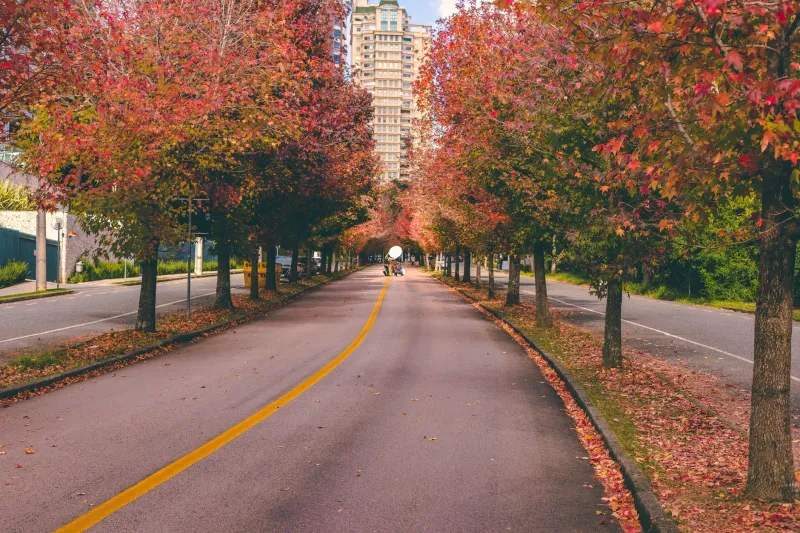
The blocks between Yonge Street and 1 Deer Park Crescent transition rapidly from commercial intensity to residential calm. The built form shifts from retail storefronts and mid-rise mixed-use buildings to detached homes, mature trees, and the quiet residential streetscapes that characterise Deer Park's interior. This transition is compressed — it occurs within a few hundred metres — but it is nonetheless complete. By the time one reaches the crescent itself, the sonic and visual character of Yonge Street has receded entirely.
This is not an accident of development history. It reflects the neighbourhood's deliberate preservation of residential zoning and built-form controls that have resisted the kind of commercial creep that has transformed comparable streets in other midtown neighbourhoods. The interval between the arterial corridor and the residential core has been, in effect, protected.
What the Commute Actually Looks Like
For the working professional — the demographic that Deer Park increasingly attracts and retains — the morning commute from 1 Deer Park Crescent is worth describing with some specificity.
The walk to Davisville Station takes approximately seven to ten minutes at a moderate pace, passing through tree-lined residential streets that are, by any standard, among the most pleasant in midtown Toronto. There are no major intersections to navigate, no commercial congestion to thread, and no acoustic intensity to endure. The walk is, for many residents, among the more agreeable parts of the working day.
From Davisville, the Yonge-University line provides direct, rapid access to the Financial District, Bloor-Yorkville, and Union Station. The entirety of Toronto's primary business and cultural geography is accessible within twenty minutes of leaving the building. By any reasonable measure, this is connectivity of the highest order.
And yet, from the interior of a suite at 1 Deer Park Crescent, none of this infrastructure is perceptible. The building does not vibrate with passing trains. The street does not carry the ambient roar of heavy commercial traffic. The neighbourhood does not smell of exhaust or fast food. The access exists entirely, and the environment reflects none of its consequences.
A Demographic Defined by Calibration
The buyers who have chosen Deer Park in recent years — and the profile is consistent enough to be described with confidence — are not making a compromise between urban access and residential quality. They are making a deliberate choice to occupy a position that maximises both simultaneously.
They are, disproportionately, professionals in their thirties and forties who have spent time living closer to the urban core and have arrived at a considered view of what they actually want from a residential address. They value the city's amenities but have developed a clear-eyed assessment of the costs that come with maximum urban exposure. They are not suburbanising — Deer Park is emphatically not a suburban address — but they are refining their relationship to the city in a way that prioritises quality of daily experience over the status of a maximally central location.
For this buyer, Deer Park's positioning is not a concession. It is a sophisticated preference, arrived at through experience and expressed through acquisition.
Beyond the Subway: The Full Amenity Radius
Transit connectivity is the most frequently cited dimension of Deer Park's urban positioning, but it is not the only one worth considering. The neighbourhood's proximity to Yonge Street also provides access to one of Toronto's most complete commercial corridors — one that includes grocery retail, professional services, restaurants, and cultural institutions — without requiring residents to navigate its intensity on a daily basis.
The practical implication is that Deer Park residents enjoy an amenity radius that is, in functional terms, as rich as that of any address in midtown Toronto. The difference is that accessing these amenities is, at this address, an intentional act rather than a constant ambient condition. One goes to Yonge Street when one chooses to. One does not live in its shadow.
This distinction — between access and immersion — is, ultimately, what Deer Park's urban position offers. And for the buyer who has thought carefully about what urban living at its best actually entails, it is precisely the distinction that matters most.