A New Guard Arrives: Why Deer Park Is Becoming Toronto's Address of Choice for the Ambitious and Established

Photo by Photo by Jason Ng on Unsplash on Unsplash
For much of the past decade, the prevailing narrative in Toronto real estate positioned downtown glass condominiums as the natural habitat of the city's rising professional class. The logic was straightforward enough: proximity to the financial core, walkability scores that impressed on paper, and a kind of visual modernity that appealed to those building careers in a city increasingly conscious of its own ambitions. That narrative, however, is quietly unravelling—and Deer Park is the neighbourhood that most clearly illustrates its undoing.
What is happening in Deer Park today is less a sudden discovery than a long-overdue recognition. The neighbourhood, bounded by its graceful crescent streets, mature tree canopy, and a built form that speaks to permanence rather than speculation, has always possessed the qualities that serious buyers eventually seek. What has changed is the profile of the buyer who is now seeking them.
The Profile of a Shifting Demographic
The incoming residents of Deer Park's finest buildings are not retirees consolidating wealth, nor are they buyers at the earliest stage of their property journey. They are, increasingly, professionals in their mid-thirties to early fifties—founders of firms, partners at established practices, senior executives navigating the upper echelons of finance, technology, and the creative industries. Many have lived in the downtown core. Some have owned there. A significant number are arriving from cities like Vancouver, Montreal, or London, bringing with them a more calibrated understanding of what a residential address should actually provide.
For this cohort, the calculus has shifted decisively. The downtown condo tower, once a symbol of arrival, has begun to feel like a liability—crowded lobbies, thin walls, management corporations stretched across hundreds of nearly identical units, and a streetscape that offers stimulation but rarely serenity. What Deer Park offers in its place is the kind of residential dignity that no amount of amenity programming can manufacture: a neighbourhood with genuine character, a street grid that rewards the pedestrian, and a social environment defined by stability rather than transience.
Heritage as a Differentiator, Not a Constraint
One of the more striking aspects of this demographic shift is the degree to which heritage—so often framed as a limitation in conversations about urban development—has emerged as a genuine draw. Deer Park's Victorian and Edwardian architectural vocabulary, its preserved streetscapes, and its relative restraint in the face of Toronto's broader development pressures have created an environment that feels earned rather than constructed.
For professionals who spend their working lives in environments designed for maximum efficiency and minimum friction, the neighbourhood's physical texture offers something quietly restorative. The experience of walking along a tree-lined crescent, past buildings that have stood for a century and are likely to stand for another, carries a psychological weight that a glass tower lobby simply cannot replicate. Heritage, in this context, functions not as nostalgia but as a form of permanence—a quality that discerning buyers are increasingly willing to pay a meaningful premium to access.
The Yorkville Adjacency and What It Actually Means
It would be incomplete to discuss Deer Park's appeal without acknowledging its proximity to Yorkville, though the relationship between the two neighbourhoods merits a more nuanced reading than simple adjacency. Yorkville provides the cultural and commercial infrastructure—the flagship retailers, the serious restaurant dining, the gallery circuit, the hotels that accommodate visiting clients and family—that makes urban life genuinely convenient for those accustomed to a certain standard. Deer Park, positioned immediately to the north, captures the benefit of that proximity without absorbing its density or its occasional brashness.
This distinction matters enormously to the incoming professional class. The ability to walk to a world-class restaurant or a significant gallery opening, and then return to a street that is genuinely quiet, genuinely residential, and genuinely removed from the commercial energy of Bloor Street, is not a minor convenience. It is, for many buyers, the precise balance they have been attempting to locate for years.
Stability as a Form of Sophistication
Perhaps the most underappreciated dimension of Deer Park's current appeal is what might be described as its institutional stability. The neighbourhood has not reinvented itself in response to each successive wave of urban enthusiasm. It has not been repositioned by developers, rebranded by marketing campaigns, or fundamentally altered by the kind of rapid densification that has reshaped other Toronto addresses beyond recognition.
For buyers who have watched neighbourhoods they once valued become unrecognisable within a single decade, this consistency registers as something close to a luxury. Deer Park's stability is not stagnation—the neighbourhood's property values, calibre of residents, and quality of amenities have all evolved in ways that reflect genuine improvement—but it is a stability that resists the volatility that defines so much of Toronto's residential landscape. That quality, increasingly rare in a city growing at Toronto's pace, has become a significant factor in the purchasing decisions of those with the means and the experience to recognise its value.
What the Arrival of This Generation Signals
The movement of affluent young professionals toward Deer Park is not simply a lifestyle trend to be noted and catalogued. It represents a meaningful signal about the direction of value in Toronto's residential market. When a generation that came of age professionally during the era of the glass tower begins actively choosing heritage neighbourhoods, walkable streets, and residential permanence over the amenities and aesthetics of the condominium complex, it indicates a maturation of taste that tends to be self-reinforcing.
Neighbourhoods that attract buyers of this profile—educated, financially established, attentive to quality—tend to hold and appreciate their value in ways that more speculative addresses cannot reliably promise. The social capital that accumulates when a neighbourhood becomes home to a concentration of accomplished, engaged residents compounds over time, expressing itself in maintained buildings, active community investment, and a residential environment that continues to reward those who choose it.
For prospective buyers considering an address in Deer Park today, the question is not whether the neighbourhood will retain its appeal. The question is whether they will act before the window of opportunity narrows further.
An Address That Has Always Known Its Own Worth
Deer Park has never required external validation. Its streets, its buildings, and its residents have long understood that the neighbourhood occupies a particular position in Toronto's residential hierarchy—one defined not by flash or novelty, but by the kind of quiet, enduring quality that serious people have always sought. The new generation of professionals now arriving is not discovering Deer Park so much as recognising, often after years of searching elsewhere, what was here all along.
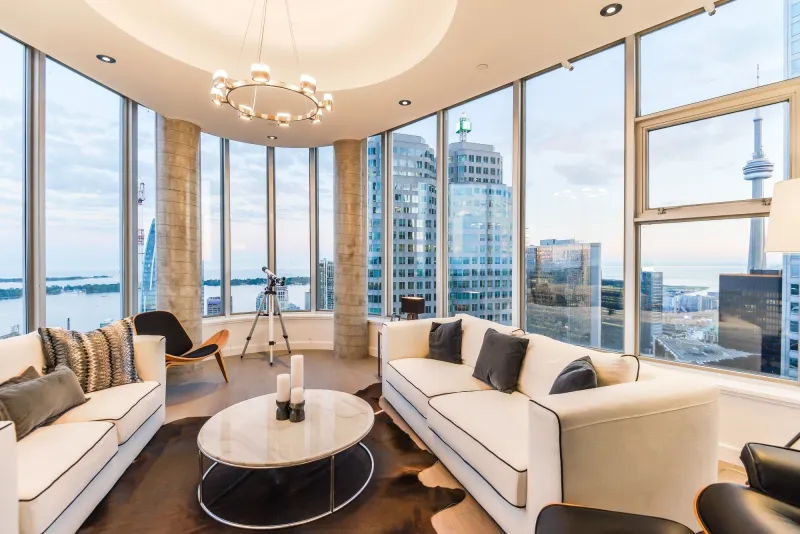
At 1 Deer Park Crescent, that recognition finds its most refined expression. Unit 803 represents precisely the intersection of heritage neighbourhood prestige, elevated suite positioning, and thoughtful residential design that defines what Deer Park, at its best, has always been able to offer.