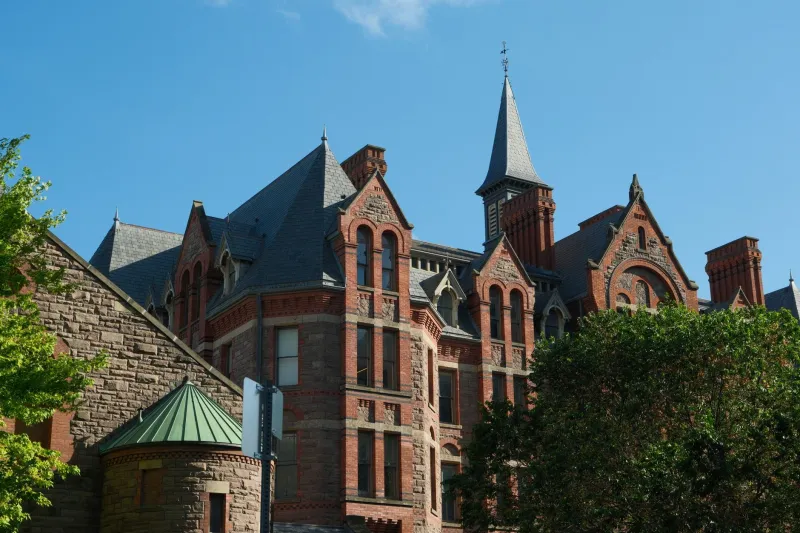
Sound Architecture: How Curved Buildings at 1 Deer Park Crescent Quietly Outperform Toronto's Glass Towers

Photo by Photo by Danylo Kondysiuk on Unsplash on Unsplash
Toronto is a city that rarely holds its tongue. From the persistent hum of the Yonge Street corridor to the ambient percussion of construction cranes and delivery vehicles, urban noise has become one of the most quietly significant factors in residential property evaluation. Yet most buyers, focused on square footage and finishes, overlook the single architectural variable that governs acoustic comfort more than any other: the shape of the building itself.
At 1 Deer Park Crescent, the curved façade is not merely an aesthetic statement. It is, in measurable acoustic terms, a structural advantage — one that separates this address from the grid of boxy glass towers that dominate Toronto's downtown skyline.
The Physics of Sound and Surface Geometry
To understand why curved architecture performs differently from flat-faced construction, one must revisit a principle from secondary-school physics: sound behaves like light when it encounters a surface. It reflects, refracts, and scatters depending on the angle and geometry of that surface.
A flat building façade acts much like a mirror — it reflects incoming sound waves directly back toward their source or, worse, redirects them at predictable angles into adjacent spaces. This is why residents on the lower floors of downtown glass towers often report that street noise feels amplified rather than absorbed. The building's geometry is, in effect, working against them.
A curved surface, by contrast, disperses incoming sound waves across a wider arc. Rather than concentrating reflected energy at a single angle, the convex geometry of a crescent-shaped building scatters acoustic pressure outward and away from the structure. The result is a measurable reduction in the intensity of sound that ultimately reaches interior spaces.
Acoustical engineers refer to this phenomenon as diffuse reflection — a principle exploited deliberately in the design of concert halls, recording studios, and high-performance architectural spaces. At 1 Deer Park Crescent, the same principle operates passively, requiring no technology, no maintenance, and no additional cost to the resident.
Comparing the Numbers: Curved vs. Rectangular Façades
While every building site presents unique acoustic variables — traffic volume, street width, surrounding vegetation, and prevailing wind direction among them — research into urban building acoustics offers instructive benchmarks.
Studies published in the Journal of the Acoustical Society of America have documented that curved building surfaces can reduce the intensity of reflected urban noise by between 3 and 8 decibels compared to equivalent flat façades under comparable conditions. To contextualise that figure: a 3-decibel reduction corresponds to a halving of acoustic power, while an 8-decibel reduction is perceptible to most listeners as a dramatic quieting of the ambient environment.
For a resident at 1 Deer Park Crescent, this architectural geometry translates into a meaningfully calmer interior — particularly in suites facing the crescent's curve, where the deflection effect is most pronounced.
The Deer Park Setting as an Acoustic Amplifier
The building's curved form does not operate in isolation. It functions within an urban context that is itself acoustically favourable in ways that downtown Toronto's denser neighbourhoods cannot match.
Deer Park's mature tree canopy — a subject explored in depth elsewhere on this site — provides an additional layer of sound attenuation. Broadleaf trees, particularly when densely planted, absorb and scatter high-frequency sound waves, functioning as a natural acoustic buffer between the street and the building. Studies conducted by Natural Resources Canada have estimated that urban tree canopies can reduce perceived traffic noise by as much as 6 to 8 decibels under optimal conditions.
The combined effect of curved architecture and mature landscaping creates what acousticians would describe as a layered attenuation system — multiple independent mechanisms working in concert to reduce the acoustic load on each suite. It is a form of environmental engineering that no amount of interior soundproofing can fully replicate, because it addresses the problem at its source rather than at the interior wall.
What Residents Notice — and What They Don't
The most telling evidence of an address's acoustic quality is often what residents fail to hear. Buyers who tour suites at 1 Deer Park Crescent consistently remark on the unexpected quietude — a stillness that feels incongruous with the building's proximity to one of Toronto's most active arterial corridors.
This is not accidental. It is the cumulative outcome of deliberate architectural geometry, mature urban landscaping, and the particular topography of the Deer Park neighbourhood, which sits at a slight elevation above the busiest sections of Yonge Street. Sound, like water, tends to travel along the path of least resistance — and the physical and architectural configuration of this address consistently redirects that path away from residential interiors.
For buyers accustomed to evaluating properties through the lens of finishes, amenities, and price-per-square-foot, the acoustic profile of a building may seem like an intangible. In practice, it is among the most consequential determinants of long-term residential satisfaction.
A Practical Buying Consideration
For those conducting due diligence on a suite at 1 Deer Park Crescent, a simple test is revealing: visit the property during peak traffic hours — weekday mornings between 7:30 and 9:00 a.m. are ideal — and assess the ambient sound level from within the suite with windows closed. Compare this experience against suites you may have toured in Toronto's downtown core under similar conditions.
The difference, for most buyers, requires no instruments to measure. It is immediately and viscerally apparent. And it is, in no small part, a consequence of the crescent itself — a shape that has been quietly managing the acoustic environment of this address long before the science to explain it was formally articulated.
In a city where silence has become one of the rarest and most coveted residential amenities, the geometry of 1 Deer Park Crescent is not merely beautiful. It is functional, measurable, and enduring.