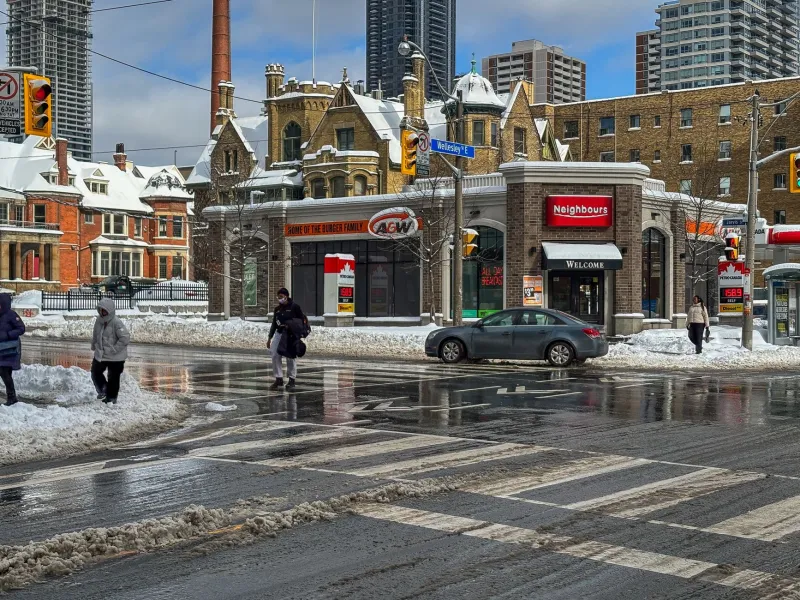
Geometry as Destiny: How Crescent Street Architecture Quietly Drives Property Value in Deer Park

In Toronto's most competitive real estate conversations, the discussion inevitably circles back to neighbourhood, building quality, and suite finishes. Rarely does it pause long enough to consider the street itself — its shape, its curvature, the way it directs foot traffic and frames a residence within the broader urban fabric. Yet for buyers and investors who have studied Deer Park closely, the arc of Deer Park Crescent is not incidental. It is, in many respects, foundational to how value is distributed across the entire address.
This is the hidden economics of crescent living: a discipline that blends architectural history, urban geography, and market behaviour into a single, quietly compelling argument for why position — not merely postal code — determines long-term property performance.
The Crescent Form: A Brief History of Intentional Urban Design
Crescent streets are not accidents of city planning. They emerged from the British Picturesque tradition of the 18th and 19th centuries, deliberately designed to create visual drama, a sense of enclosure, and a hierarchy of address that grid-based streets simply cannot replicate. In cities like Bath, Edinburgh, and — closer to home — in Toronto's older residential enclaves, the crescent was reserved for aspirational living. It signalled permanence, selectivity, and a relationship between architecture and landscape that the standard urban block was never meant to achieve.
Deer Park Crescent carries this lineage. Its gentle curve through one of midtown Toronto's most established neighbourhoods is not merely scenic; it is structurally productive. The arc creates a series of differentiated positions along its length, each with its own exposure profile, sightline quality, and relationship to pedestrian movement. Where a straight street distributes these qualities relatively evenly, a crescent concentrates and varies them — and the market, over time, prices that variation accordingly.
Corner Exposure and the Premium It Commands
Within any crescent, corner positions function differently than mid-block units. The physics are straightforward: a corner residence receives light and air from multiple orientations simultaneously. But the economics run deeper than solar gain.
Corner exposure in a crescent context means something architecturally specific. Because the street curves, a corner unit at the arc's inflection point commands a sightline that extends along the crescent's length in both directions — a panoramic relationship with the street that no mid-block position can replicate. This is not merely aesthetic. It translates into perceived prestige, which in turn influences both listing price and the speed at which a property attracts qualified buyers.
In Toronto's resale market, data consistently demonstrates that units with superior light exposure and differentiated street presence outperform comparable square footage in less advantaged positions. The premium is rarely dramatic in any single transaction, but compounded across a holding period of five to ten years, the differential becomes material. For investors and owner-occupiers alike, this is the kind of structural advantage that does not erode with market cycles.
Pedestrian Flow and the Psychology of Arrival
There is a subtler dynamic at work along Deer Park Crescent that rarely appears in listing descriptions but is immediately legible to anyone who has spent time in the neighbourhood: the way pedestrian traffic moves along a curved street is fundamentally different from movement along a straight one.
On a grid street, foot traffic is directional and largely indifferent to individual addresses. On a crescent, the curve naturally slows movement. Pedestrians orient themselves differently, pausing to read the street's arc, to appreciate the sequence of facades, to experience the enclosure that the form creates. This has measurable consequences for how a property is perceived — both by prospective buyers during viewings and by the broader community over time.
Addresses that benefit from this pedestrian engagement — those positioned at the crescent's most visually prominent points — carry an ambient prestige that is difficult to quantify but impossible to ignore. They are the addresses that neighbours reference when describing the street. They are the ones that appear in neighbourhood photography. They are, in the language of real estate, the aspirational benchmarks against which comparable properties are measured.
Rental Potential and the Microlocation Advantage
For investors considering Deer Park Crescent as part of a rental portfolio, the microlocation argument becomes even more pronounced. Toronto's premium rental market is driven by tenants who are themselves sophisticated about address quality — executives on corporate relocation packages, professionals seeking proximity to midtown offices and the Yonge Street corridor, and internationally mobile individuals who understand the difference between a desirable neighbourhood and a desirable position within that neighbourhood.
A suite that benefits from corner exposure, superior sightlines, and the quiet prestige of a well-positioned crescent address will consistently attract tenants from the upper tier of the rental market. These tenants tend to stay longer, maintain properties with greater care, and accept modest annual rent adjustments without the friction that more transient tenants introduce. The economic consequence is a more stable, higher-yielding asset — one that performs not just in rising markets but maintains its relative position during periods of broader softening.
What the Crescent Teaches Buyers About Due Diligence
The broader lesson that Deer Park Crescent offers to any serious Toronto buyer is one of granularity. Premium neighbourhoods are not monolithic. Within even the most desirable postal codes, there are positions that outperform and positions that merely perform — and the difference is often invisible to buyers who rely solely on neighbourhood reputation or building amenity lists.
The questions that discerning buyers should be asking are specific: Where does this unit sit relative to the street's curve? What is its light exposure across the full arc of the day? How does it relate to pedestrian movement and street-level visibility? Does its position within the building correspond to a structurally advantaged position on the crescent itself?
At 1 Deer Park Crescent, unit 803 represents the kind of considered positioning that these questions are designed to identify. Elevated above the street-level noise while remaining intimately connected to the neighbourhood's architectural character, it occupies a vantage point that is as much a product of the crescent's geometry as it is of the building's own design. That is not coincidence. It is the result of the crescent form doing precisely what it was always intended to do: creating a hierarchy of address in which the most advantaged positions are self-evidently, enduringly superior.
The Long View
Toronto's real estate market rewards patience and precision in roughly equal measure. Buyers who understand that value is distributed unevenly — even within a single street, even within a single building — are positioned to make acquisitions that appreciate not merely because the market rises, but because the specific asset they hold occupies a structurally superior position within it.
Deer Park Crescent has been producing this kind of quiet outperformance for decades. The curve of the street is not decorative. It is economic. And for those who have learned to read it correctly, it remains one of midtown Toronto's most reliable signals of long-term residential value.