Rooted in Value: Why Toronto's Heritage Neighbourhoods Consistently Outperform the Market
Toronto is a city that reinvents itself with remarkable speed. Cranes punctuate the skyline from Liberty Village to the North York Centre corridor, and new condominium towers seem to emerge from the ground with each passing season. Yet beneath this perpetual churn, a quieter truth asserts itself for those willing to look carefully: the neighbourhoods that hold their value most reliably are rarely the newest ones. They are the oldest.
Deer Park is a compelling case study in this phenomenon. Tucked between the bustle of Yonge and St. Clair to the south and the residential serenity of Forest Hill to the north, this mid-town enclave has demonstrated a consistency of desirability that newer master-planned communities have found difficult to match. For prospective buyers evaluating 1 Deer Park Crescent, Unit 803, the neighbourhood itself is not merely a backdrop — it is a fundamental component of the investment thesis.
The Anatomy of a Heritage Neighbourhood
What distinguishes a heritage neighbourhood from a simply old one? The answer lies in the layering of permanent, non-replicable assets. Deer Park possesses several of these in abundance.
First, there is the urban canopy. The mature trees lining streets such as Heath Street West and Deer Park Crescent itself took generations to reach their present scale. No developer can install a century-old oak. This greenery contributes measurably to air quality, ambient temperature regulation, and the sensory experience of daily life — factors that, according to various urban planning studies, translate directly into property premiums. In Toronto's increasingly dense urban core, proximity to established green infrastructure is a diminishing resource.
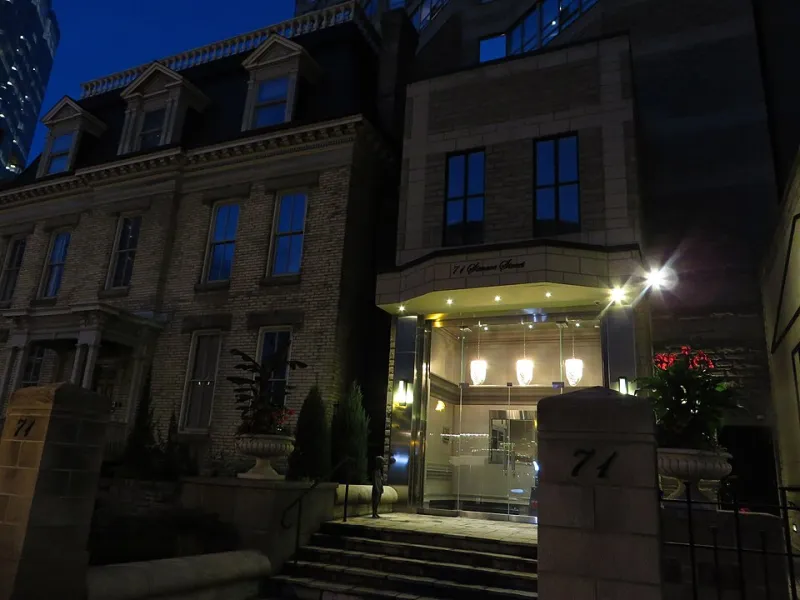
Second, there is architectural coherence. Deer Park's residential fabric blends pre-war detached homes, Edwardian rowhouses, and thoughtfully integrated mid-century and contemporary buildings. This visual continuity signals neighbourhood stability to buyers and lenders alike. Communities that lack this character — where towers stand in isolation from any meaningful streetscape — tend to experience sharper valuation volatility during market corrections.
Third, and perhaps most critically, there is institutional permanence. Deer Park is anchored by Upper Canada College, the Toronto Reference Library, and the cultural corridor of Yonge Street, all within close reach. These institutions do not relocate. They generate consistent foot traffic, employment, and a self-reinforcing cycle of demand from families and professionals who prioritise proximity to them.
Accessibility Without Sacrifice
One of the persistent tensions in Toronto real estate is the trade-off between urban connectivity and residential calm. Buyers who prioritise transit access often find themselves in high-density corridors where noise, congestion, and a sense of impermanence undercut quality of life. Those who retreat to quieter enclaves frequently discover that commuting becomes its own burden.
Deer Park resolves this tension with unusual elegance. The St. Clair subway station places residents within minutes of the downtown financial core, Yorkville, and Union Station without requiring them to live amid the density of those areas. Davenport Road and Avenue Road provide arterial road access for drivers, while the neighbourhood's walkability score reflects the proximity of independent grocers, specialty retailers, and a genuinely varied dining scene.
For the occupant of Unit 803, this means the conveniences of a major metropolitan centre are accessible on demand, while the immediate environment retains the measured pace of a residential enclave. This duality is exceedingly difficult to manufacture in newly developed neighbourhoods, which typically must choose one character or the other.
Investment Resilience Through Market Cycles
Canadian real estate has navigated several significant corrections over the past two decades, and Toronto's market has been no exception. Yet an examination of heritage mid-town neighbourhoods reveals a consistent pattern: properties in areas like Deer Park, Rosedale, and Moore Park tend to compress less dramatically during downturns and recover more swiftly when conditions improve.
The reasons are structural. Heritage neighbourhoods attract a buyer profile that is, on the whole, less leveraged and less speculative than those purchasing in newly launched condominium towers. Owner-occupiers who select Deer Park are typically motivated by lifestyle continuity rather than short-term capital gains, which moderates the panic-selling behaviour that amplifies corrections elsewhere. Rental demand in these areas also remains robust due to proximity to employment and institutional anchors, providing landlord-investors with a meaningful buffer during periods of price softness.
Furthermore, supply constraints work in favour of heritage neighbourhood buyers. Zoning regulations, heritage designations, and the simple absence of available land limit new development in Deer Park in ways that are simply impossible in emerging districts. When demand rises, supply cannot respond with the same elasticity it can in a greenfield development zone. The arithmetic of scarcity, over time, favours the patient owner.
Unit 803 Within the Larger Narrative
A single suite is always, in part, a product of its surroundings. Unit 803 at 1 Deer Park Crescent does not exist in isolation from the neighbourhood that gives the building its name and address. The mature streetscape visible from an upper-floor perspective, the proximity to David A. Balfour Park, and the cultural richness of the broader mid-town corridor are not amenities that can be listed on a specification sheet — yet they are precisely what discerning buyers pay for and what time consistently rewards.
For those approaching Toronto real estate with a long-term perspective, the question is not simply which suite offers the best current value per square foot. The more instructive question is which neighbourhood has demonstrated, across generations, the capacity to remain desirable regardless of what the broader market does. In Deer Park, that answer has remained consistent for well over a century.
The fundamentals that made this neighbourhood exceptional in the early twentieth century — its green character, its institutional anchors, its measured density, and its connectivity — remain fully intact today. That continuity is not accidental. It is the product of a community that understood, long before the language of urban planning made it fashionable, that the most durable investment is one made in a place people will always want to be.