Between the Ground and the Sky: How Elevation at the Eighth Floor Redefines Year-Round Comfort in Toronto
Most buyers in Toronto's condominium market spend considerable energy evaluating suite finishes, square footage, and proximity to transit. Fewer pause to consider the floor itself as a determinant of livability. Yet for those who have experienced the full arc of a Toronto year—from the biting cold of February to the humid weight of August—the storey on which you reside is not a trivial detail. It is, in fact, one of the most consequential variables in daily residential life.
Unit 803 at 1 Deer Park Crescent sits at an elevation that occupies a genuinely advantageous position within the building's vertical spectrum. Not so low as to absorb the full force of ground-level weather patterns, and not so high as to be exposed to the unmoderated turbulence of the upper atmosphere. This mid-upper range—what urban climatologists sometimes refer to as the "thermal middle"—offers a calibrated residential experience that neither extreme can reliably provide.
Toronto's Microclimate Is More Complex Than It Appears
Toronto is often described as a city of four distinct seasons, but that phrase understates the meteorological nuance that residents actually navigate. The city's position on the north shore of Lake Ontario creates a dynamic where lake-effect weather patterns interact with inland topography in ways that vary considerably by neighbourhood—and even by building elevation.
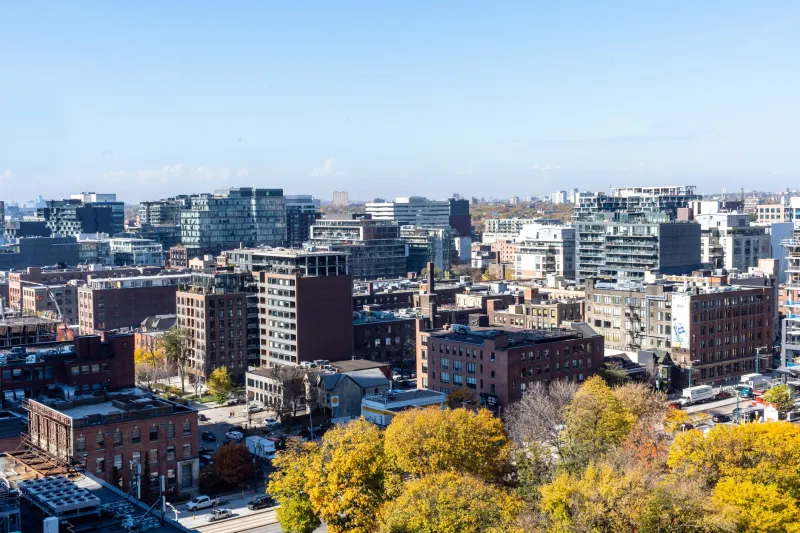
Deer Park, situated north of Bloor Street and adjacent to the ravine system that threads through midtown, has its own microclimate signature. The ravine acts as a natural corridor for air movement: cool in summer as tree cover retains moisture and moderates temperature, and channelled in winter as cold air follows the grade northward. Ground-level suites in buildings along this corridor absorb the full effect of this air movement. Ultra-high-rise units, meanwhile, are exposed to the broader atmospheric conditions above the urban canopy—conditions that are faster, colder in winter, and more variable throughout the day.
The eighth floor sits meaningfully above the ravine's immediate influence while remaining sheltered from the more aggressive upper-atmosphere dynamics. This is not a coincidence of design; it is a consequence of thoughtful positioning within a building that was conceived with its natural surroundings in mind.
Winter: Sheltered Without Being Sealed Off
Toronto winters are characterised not merely by cold temperatures but by wind chill—the compounding effect of low temperatures and sustained air movement. In Deer Park, the ravine system can accelerate this dynamic at ground level, where air funnels through the natural corridor with considerable force during January and February.
Residents of lower floors in this area frequently report a sensation of exposure that is not fully accounted for by temperature readings alone. The wind finds gaps, creates drafts, and amplifies the psychological weight of the season. At the eighth floor, this effect is substantially attenuated. The building's structure, combined with the elevation above the most active air-movement zone, produces an environment where winter is experienced as genuinely cold but not relentlessly harsh.
From an energy perspective, this matters as well. Suites less exposed to direct wind pressure require less heating effort to maintain consistent interior temperatures. The thermal envelope of a well-constructed mid-upper floor unit performs more efficiently than one at grade, where ground contact and surface wind work in concert against insulation.
Summer: Elevated Above the Urban Heat Island
Summer in Toronto has grown warmer over successive decades, and the urban heat island effect—the phenomenon by which dense urban surfaces absorb and re-radiate heat—is well documented in the city's core. At street level, this effect is most pronounced. Pavement, vehicle traffic, and building surfaces combine to create temperatures that can exceed surrounding areas by several degrees Celsius during peak afternoon hours.
Elevation provides a partial remedy. By the eighth floor, the suite is above much of the re-radiated heat that accumulates at grade. Air circulation at this height is more consistent, reducing the stagnant warmth that can make lower-level urban suites uncomfortable even with mechanical cooling. Natural ventilation—the ability to open windows and allow genuine air exchange—becomes a practical option rather than a theoretical one.
The proximity of the ravine canopy also contributes a cooling influence during summer months. The tree mass to the south and east of 1 Deer Park Crescent acts as an evaporative system, releasing moisture into the air and moderating ambient temperature. At the eighth floor, this benefit is accessible without the density of shade that can reduce natural light for lower suites during the warmer months.
Spring and Autumn: The Transitional Advantage
Perhaps the most underappreciated seasonal benefit of the eighth-floor elevation is experienced during Toronto's transitional periods—the extended shoulders of spring and autumn when weather is variable and the gap between a pleasant day and an uncomfortable one can be measured in hours.
At this elevation, the suite responds to seasonal change with a degree of thermal stability that lower floors often cannot achieve. Morning temperatures that might feel sharp at street level are softened by the combination of solar gain and reduced wind exposure. Evening cool-down, which can arrive abruptly at higher elevations during autumn, is moderated by the building's mass and the retained warmth of the urban environment below.
For residents who value the ability to use their living space—balconies, open windows, natural ventilation—throughout the shoulder seasons, this stability translates directly into additional weeks of comfortable outdoor and semi-outdoor living each year.
Light, Air Quality, and the Psychological Dimension
Climate experience is not purely physical. The quality of light at the eighth floor—elevated above obstruction by street-level vegetation and neighbouring structures—contributes to a sense of openness that affects mood and wellbeing in ways that are increasingly well supported by research. Natural light exposure is linked to circadian regulation, energy levels, and overall satisfaction with one's residential environment.
Air quality, too, improves with modest elevation. Particulate matter from vehicle traffic is most concentrated at street level and disperses with height. While the difference between the ground floor and the eighth is not the same as moving to the countryside, it is a measurable and meaningful distinction for those who spend significant time at home.
A Position Worth Considering
For the prospective buyer evaluating 1 Deer Park Crescent, the question of elevation deserves the same careful consideration given to suite layout or building amenities. Unit 803 occupies a position that has been shaped—whether by design or fortunate circumstance—into a genuinely advantageous climate zone within the building's vertical range.
In a city where seasonal extremes are a defining feature of residential life, the floor on which you live is not a footnote. It is a daily experience, repeated across every morning, every evening, and every season for as long as you call the suite home. At the eighth floor, that experience is one of calibrated comfort—sheltered from the worst, open to the best, and positioned to make the most of everything Toronto's remarkable climate has to offer.